Thursday, January 23, 2014

Untold Stories of 2013: When Insects Attack!

While we wait for spring to come, I thought I would share some of my untold gardening stories from 2013. The blog posts I started and never finished.

One of the things I remember most about 2013 was the invasion of insect pests in the garden. Perhaps "plague" would be a more accurate word. Insect pests were everywhere. Some caused quite a bit of damage, while others were more of a nuisance. Some of of these invaders I had never seen before. 


The insect to cause the most widespread damage was probably the colorful Four Lined Plant Bug. I never got a good picture of this critter because they drop from the leaf they are feeding on when you approach. I did happen to get a picture of one having its juices sucked out by an Assassin Bug. Still not a great photo.

Having your juices sucked out by an Assassin Bug is a fitting fate for a Four Lined Plant Bug because that is what they did to the leaves of my Gregg's Mistflower, Gregg Salvia, and Liatris. You can see some of the damage in the upper left of the photo above. Since Gregg's Mistflower and Gregg Salvia grow so fast, they quickly outgrew the damage to their leaves.

The damage to the Liatris, however, was so intense and prolonged that the leaves turned almost white with scabs and I think it cause several of the plants to die when they began blooming. I must say that I am not 100% certain that the damage to the Liatris was caused by the Four Lined Plant Bug, but I am pretty certain.

I tried controlling the Four Lined Garden Bug with a light horticultural oil, but since the insects drop to the ground when they feel threatened, they are hard to hit with a spray of the oil. 

Light horticultural oil is the strongest insecticide I use and I only use it on rare occasions. It is paraffin based must come in contact with the insects to kill them by suffocation. If you can't coat the insect with spray, it will not die. Light horticultural oil also works pretty well on leaf fungus too.

Grasshoppers are always present in Texas. In fact, I disturbed a 3.5 inch long one in the garden this past weekend. The season started out looking like it would be a bad grasshopper year, but I never noticed any more damage than is visible on these rain lily flowers.

The Coreopsis Leaf Beetle is another pest that caused damage last year, specifically to Coreopsis plants. My photos of this insect must have been really bad and I deleted all of them. You can see a great photo and find more information at the link. This beetle pretty much destroyed all of my Correopsis plants last year. I used light horticultural oil a couple of times to control this pest.

I have four varieties of milkweed plants to provide food for monarch caterpillars. I knew when I planted them that I would also have aphids. The two seem to go hand in hand or plant in mouth. 

The aphid infestation on the milkweed was actually pretty light last year. They hit once in the spring and never again. They are fairly easy to keep under control by spraying them off the plants with a strong stream of water from a hose. There are almost always a few lady bug beetles and their larva feeding on the aphids too.


Another pest common to milkweed is the Milkweed Bug. They appeared in the garden about three years ago and feed on the milkweed seedpods. The do not seem to do much damage to the plants otherwise, but they are very prolific. I keep them under control by squishing them between my thumb and forefinger, usually gloved, but not always.

A newcomer to attack the milkweed in my garden is the Swamp Milkweed Beetle. To the uninformed, this pest might look like a large lady bug. Instead of eating aphids, like a lady bug, the Swamp Milkweed Beetle will quickly defoliate milkweed plants. I have only seen the beetle on tropical milkweed in my garden. It does not seem to bother the native varieties of milkweed. This is another pest that is easy to control by the squishing method.


Who knew that an insect attacks the Texas Bluebonnet? I did not, until last year when I found the seedpods covered with Conchuela Bugs. This was another new pest to me. They began appearing after the seedpods began forming. I assume they were feeding on the developing seeds. 

My method of control for the Conchuela Bugs was to move the Bluebonnet plants to the compost pile before all of the seeds were mature. 

Leaf footed Bugs are regular visitors to my Red Yucca plants each year. They hang out and feed on the flower stalks and seedpods. The only thing I do to control these pests is to remove the seedpods. This seems to make them go away for a while until more seed pods form. The plants look better without the seedpods too. Once the flower stalks are about bloomed out, I cut them off and the Leaf footed Bugs will go away, but not far. 

They also like Datura leaves and seedpods. 

Flea Beetles appear during the summer and eat holes in the leaves of some Clammyweed plants. It is interesting that the insects will make some of the plants look like their leaves are made of lace, while a plant inches away will go untouched. The Clammyweed is usually about bloomed out by the time the Flea Beetles hit so it is not much of a loss. Besides that, I am removing the plants by this time of year to keep them from reseeding too freely.
And who could forget the attack of the Big Yellow Caterpillar? 

Tuesday, December 24, 2013

Christmas 2013

Happy Christmas to all, and to all a good-night.

Christmas Cactus, Opuntia christmaslightii.

Wednesday, December 11, 2013

Save the Prairie at Oak Point - Part 2

This is my second post on the prairie remnant at Oak Point Park and Nature Preserve in Plano. Preservationists have been working with the city to save the prairie and as much of the surrounding wildlife habitat as possible because starting next year, Oak Point will host the Suburbia Music Festival on the grounds adjacent to the prairie and the plan is to add additional stages in subsequent years. My understanding is that the city has been very responsive to the concerns of the native plant enthusiasts and the main prairie area will be enclosed with a split rail fence. Interpretive signs will be added to educate the public on this bit of natural history.

My first visit to this prairie remnant and the surrounding area was on 11-2-13 when Carol Clark, the president of the Collin County Chapter of the Native Plant Society of Texas, showed me around. I came back on my own on 11-16-13 to see how the prairie had changed after our first freeze of the season and to see if I could locate any plants I did not notice the first time around. I also wanted to collect a few False Boneset, Brickellia eupatoroides, seeds to distribute in my garden.


This is part of the main prairie area. Even though there are no flower blooming, I really like the look of the different shades of brown of the prairie plants, the light reflecting off the fuzzy seedheads of the Liatris, the green Arkansas Yucca, and the greens and yellows of the trees in the background.


A closer look at some of the Arkansas Yucca.


A closer look at the Liatris.


Looking in the opposite direction there are more shades of brown, tan, gray, and green.


The bright yellow fruits of this plant in the Solanum family were hard to miss. The plant is in the same family as tomatoes, but not recommended for consumption because it is said to be poisonous.


The leaves of Elbow Bush, Forestiera pubescens, are turning yellow before the fall. In late winter, this will be one of the first plants to bloom and, soon after, the plant will be covered with dark purple fruits until the birds eat them.


Roughleaf Dogwood, Cornus drummondii, has white fruits at the end of red stems. I was a little surprised to see the fruit still on the small trees because they are said to be favored by many species of birds.


Most of the leaves have fallen from the larger Roughleaf Dogwoods. These shorter sucker stems were still covered in red leaves.


Looking across Los Rios Blvd, (you can't see it, but it is a two lane road situated between the two fence lines in the photo above) the brightly colored leaves of the trees in the distance caught my eye. This is the western edge of the park. In the distance is a water tower for the city of Parker.


After crossing the fences and road, I came upon this small bushy tree with leaves in shades of red, orange, and yellow. I am pretty sure this is Common Persimmon, Diospyros virginiana. Area coyotes eat the fruit.


Smooth Sumac, Rhus glabra.


Eastern Red Cedar, Juniperus virginiana.


By Texas standards, this was a great year for fall color. I approached this group of trees for closer inspection.


Just inside the tree line, I found this Rusty Blackhaw Viburnum, Viburnum rufidulum. 


Here is a closer look at the blue black fruits. I brought a few home to see if I could get them to sprout.


Many of the trees in this area were oaks. I am not sure if they are native to this area or if birds or other animals transported acorns to the area. Either way, they are quite colorful.


I did not venture into the woods on this visit, but I will on another occasion. There is a creek not too far into these woods that I would like to see.


Shelf fungus growing on a tree trunk.


Looking up into the tree canopy.


One last look at the colorful trees.


As mentioned in the prior post, much of the grass in the preserve is the exotic invasive King Ranch Bluestem. However, there are some natives trying to reestablish the prairie such as this Silver Bluestem of the Bothriochloa species. I have always liked the look of this grass and would not mind if it grew in my garden.


As I begin heading back to the car, I turn back in the opposite direction for one last look. An Arkansas Yucca is in the foreground and several red leafed Smooth Sumacs are in the background.


Just then, a Field Sparrow flew by and landed on a tree branch. It held still long enough for me to get a poorly focused photo.


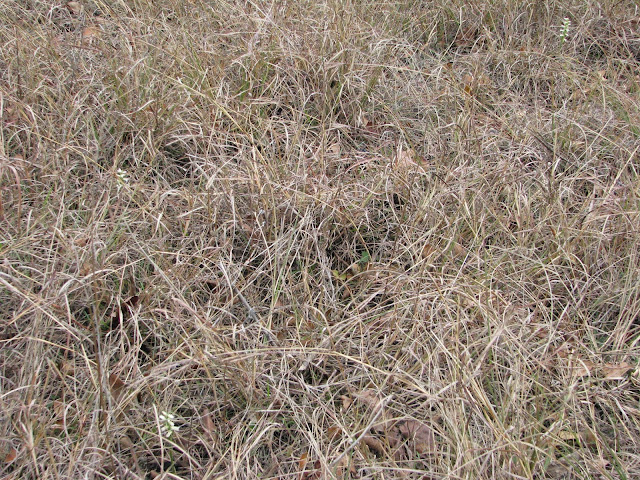
Heading back to the car again, a white flower caught my eye and then another and another. Five in all. These are Spiranthes orchids. Three of them are visible in this picture at 1, 7, and 9 o'clock.


Here is a close up of one of the Spiranthes orchids.
 
Carol told me that the orchids would be easy to spot once I knew what to look for and she was right. I think it is probably much the same with the prairie remnants at Oak Point. Many people may just see a field, but once you know what to look for, there is so much more to see and discover.