
A few weeks ago, I added a post about the butterflies that visit my prairie. Where there are butterflies, there are almost always bees because they both are attracted to the same flowers for nectar. Bees also collect the pollen from the flowers, like this bumble bee (probably a carpenter bee according to Kim at Texas Bee Watchers) on Mexican hat in the photo below.

It is surprising how many people there are that do not realize how important bees are. Many of our food crops require bees and other insects for pollination. Without these insects, the pollen is not distributed and the plant may not produce fruit. In parts of China, people must hand pollinate the flowers on pear trees because there are no bees.
Sadly, misinformed and uninformed people want to kill bees because they are afraid of them. There is no reason to be afraid of bees. Sure they can sting, but they will not bother you unless you bother them. They are too busy flying from flower to flower to collect pollen to think about you.
I recently heard about the Texas Bee Watchers website. The website promotes awareness of native bees and gives suggestions for attracting and maintaining bees. Earlier this year, the website challenged Texans to plant 52 bee gardens in 52 weeks. The year is almost over and they only have nine certified bee gardens listed on their website.
My suburban prairie has been around for a couple of years and continues to grow as I remove more of the turf grass and plant more native prairie grasses, flowers, shrubs and trees. It is always buzzing with a variety of bees and is already certified as a wildlife habitat and a monarch waystation, so I am submitting my prairie for consideration as a certified bee garden too.
Here is a look back to warmer days and some of the bees and other pollinators that visit my prairie. I do not know all of their names, but I am learning. At the end of the post are several plants and features of my prairie that attract bees.

This is a view into the backyard prairie. The snow on the prairie in the center attracts a number of pollinators in late summer.

In the front yard prairie are several flowers that attract bees at different time of the year. Starting at the top left of this photo are red yucca, datura, Gregg's mistflower, zexmenia, cowpen daisy, Mexican buckeye, mealy blue sage, scarlet sage, four nerve daisy, chocolate daisy, and Gregg dalea. In the background is a crepe myrtle in a neighbor's yard. It has lots of flowers, but they are not particularly attractive to bees.

Here is a close up of the mealy blue sage and scarlet sage in the above photo. If you look closely, there is a bumble bee (possibly a carpenter bee as well) on the mealy blue sage.

Here is a European honeybee sipping nectar on gayfeather.
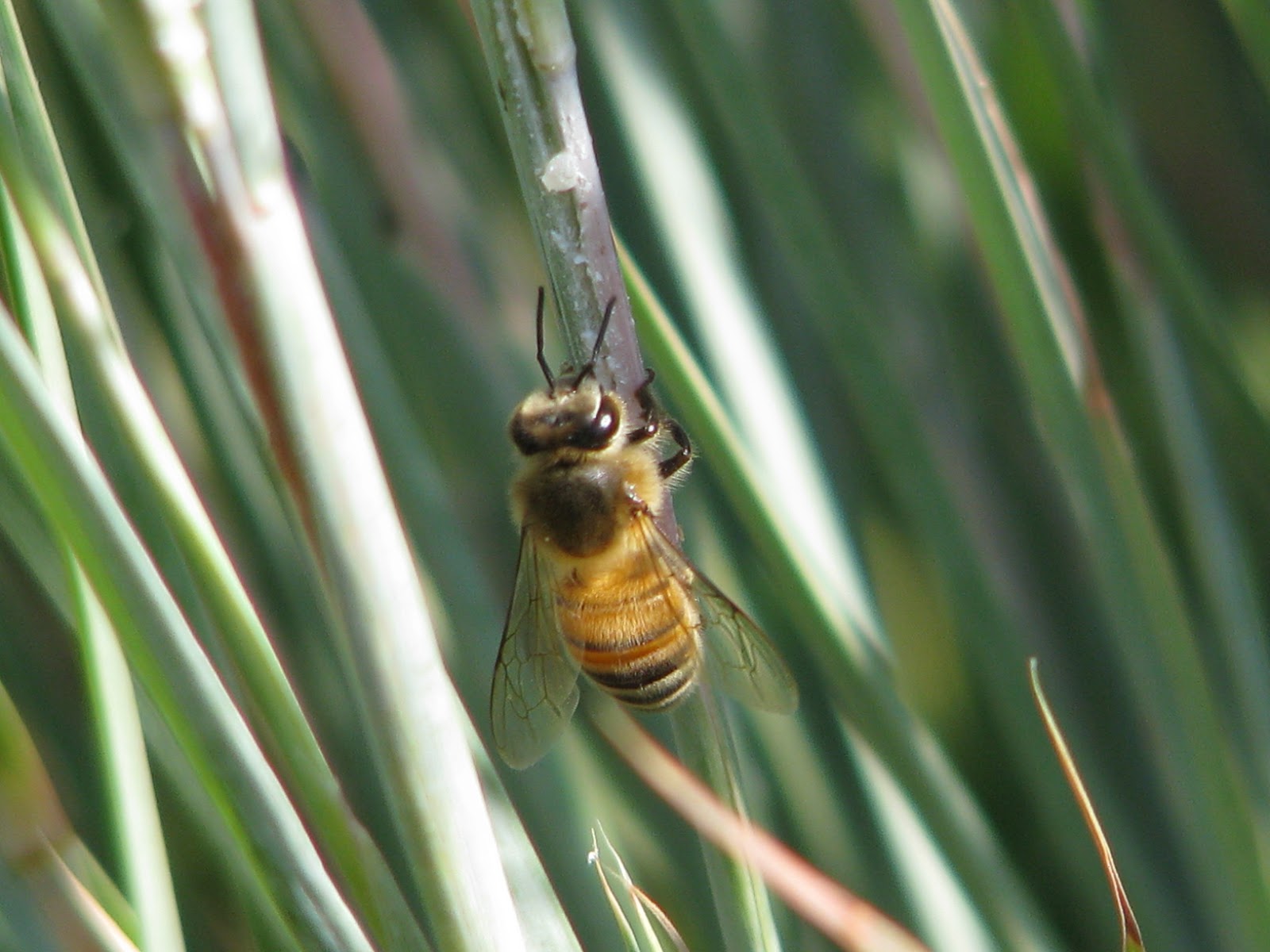
This bee is collecting something on little bluestem. The grass was full of bees doing the same on this day. I had never noticed bees taking an interest in grass before.

I think these are some type of mason bee (possibly longhorn bees - named for their long antenna - according to Kim). They appear in the yard early in the season and spend the day collecting pollen. At night, they cluster together on plants in the backyard and kick the pollen off of their legs. I feel sorry for them. It seems like they are missing something in their lives. Maybe a home? They did not show any interest in the mason bee house I bought for them. Anyone know what they are and what they need? They come back every year and disappear sometime during the summer.

Here is a bee collecting pollen on four nerve daisy.

This wasp is on Gregg's mistflower.

Frostweed attracts many pollinators when it blooms in late summer.

Here is another wasp on frostweed.

I think this is a fly. It looks a lot like a bee. The flower is fragrant mistflower.

This is probably some kind of fly too. It is on a zexmenia flower.
Here is a list of some of the favorite bee plants on my prairie:
Frogfruit, Phyla nodiflora Beebrush, Aloysia gratissima
Mexican Bird of Paradise, Caesalpinia gilliesii
Angel’s Trumpet, Datura wrightii
Greggs Mistflower, Conoclinium greggii
Zexmenia, Wedelia hispida
Salvia species – Gregg, Mexican Bush, Mountain, Mealy Blue, Picher
Prairie verbena, Verbena bipinnatifida
Pink Skullcap, Scutellaria suffrutescens
Desert Willow, Chilopsis linearis
Mexican Hat, Ratibida columnaris
Frostweed, Verbesina virginica
Fragrant Mistflower, Eupatorium havanense
Possumhaw Holly, Illex decidua
Yaupon Holly, Illex vomitoria
Gregg Dalea, Dalea greggii
Fall aster, Symphyotrichum oblongifolium
Goldenrod, Solidago rugosa
Horsemint, Monarda citriodora
Snow on the prairie, Euphorbia bicolor
Help Texas Bee Watchers meet their goal of 52 bee gardens and submit your garden before the end of the year. If your garden does not swarm with bees during the warmer months, go to their website for information that will help you provide a habitat for bees.
Frogfruit, Phyla nodiflora Beebrush, Aloysia gratissima
Mexican Bird of Paradise, Caesalpinia gilliesii
Angel’s Trumpet, Datura wrightii
Greggs Mistflower, Conoclinium greggii
Zexmenia, Wedelia hispida
Salvia species – Gregg, Mexican Bush, Mountain, Mealy Blue, Picher
Prairie verbena, Verbena bipinnatifida
Pink Skullcap, Scutellaria suffrutescens
Desert Willow, Chilopsis linearis
Mexican Hat, Ratibida columnaris
Frostweed, Verbesina virginica
Fragrant Mistflower, Eupatorium havanense
Possumhaw Holly, Illex decidua
Yaupon Holly, Illex vomitoria
Gregg Dalea, Dalea greggii
Fall aster, Symphyotrichum oblongifolium
Goldenrod, Solidago rugosa
Horsemint, Monarda citriodora
Snow on the prairie, Euphorbia bicolor
Help Texas Bee Watchers meet their goal of 52 bee gardens and submit your garden before the end of the year. If your garden does not swarm with bees during the warmer months, go to their website for information that will help you provide a habitat for bees.


