On April 25 and 26, I shared my garden with the Plano Garden Club for their garden tour.
I intended to take a few pictures of the tourists in the garden, but I was so busy answering questions and talking about the garden that I never had a chance. This is an image from one of my security cameras showing a backyard full of visitors and me answering questions about my homemade cattle panel tomato cages and arch. There was a constant flow of visitors almost the entire time.
I don't know how many people passed through the garden on those two days. I was told they sold about 350 advance tickets and then sold more on the days of the tour.
I was very happy that the bluebonnets were still in bloom. There were several questions about the bluebonnets. I explained several times that bluebonnets are annual plants and that it is necessary to let them go to seed in order to have plants for next year. I also explained that I harvest the seeds after the seed pods turn brown and keep them in the garage September when I throw the seeds in the garden where I would like them to grow.
Surprisingly, there were a few people that asked for the name of the blue flowers. I was caught off guard because I thought everyone knew what a bluebonnet was. Two visitors explained that they were visiting from a northern state (either Michigan or Wisconsin) and another woman was originally from another country.
Several people were interested in the Gulf Coast Penstemon. Some lost interest when they found out that the plants have a short bloom period and that all of my patches of the flowers in the front yard and backyard started from a single plant. Yes, it reseeds freely.
On the right side of this picture is a Hercules Club tree. It was in full bloom for the tour. The flowers are not much to look at, but they are extremely fragrant and very attractive to bees.
Here is a closer look at the Hercules Club flowers. Watch out for the rose-like thorns on the trunk, twigs, and leaves! I saw a couple of people grab a branch to get a better whiff of the flowers and get stuck in the process.
Interesting information about the Hercules Club and the closely related Toothache Tree is that it chewing on the leaves or stems will numb your mouth, the trees are a host plant for Giant Swallowtail Butterfly caterpillars, and the caterpillars look like bird poop. Unfortunately, I could not find any caterpillars to prove my point.
A number of people were interested in my decomposed granite pathways. I estimated that it took about 20 pickup loads. I don't know how many loads it actually took. I just remember it was a back breaking job unloading it from the truck and hauling it around in the garden. Of course, I always did it in the heat of summer.
Most visitors were not familiar with Penstemons and I have several in my garden. The red leaves of the Husker Red Penstemons were attracting attention. A few flowers were blooming on Saturday and even more on Sunday. The Hill Country Penstemon (not pictured) was also in bloom. The Prairie Penstemon just lost its last flower and the Rock Penstemon has yet to bloom this year.
As with last year's Plano Water-Wise Landscape Tour, the Horsetail Reed in the stock tank was a favorite topic for discussion.
Gulf Coast Penstemon and Autumn Sage. Several of my Autumn Sage plants are infested with Four Line Plant Bugs. A few visitors noticed the mottled spots on the leaves and asked what was caused them because they had the same problem on their plants.
I was able to point out this nasty little bug with the red belly so they would recognize the culprit on their own plants.
Fortunately, the damage caused by this pest is temporary, but it sure has become a growing annoyance over the last couple of years. It favors plants in the mint family, like Salvias. It is also going after my Chocolate Daisies, Skeleton-leaf Goldeneye, and Liatris.
Calling an insect "bad" because it eats plants is easy for most people to understand. The fact that I grow several plants just so they can be eaten by butterfly caterpillars is not as easy for some to understand. One example is the Wooly Pipevine. Some people lost interest in the plant after I turned over a leaf to reveal several little Pipevine Swallowtail caterpillars like the one above. Still, there were several people interested in my butterfly host plants, such as my several varieties of Milkweed, Passionvine, and Bronze Fennel.
For anyone interested in making copper pipe trellises like the one my Pipevine grows on, you can find plans on this website.
Speaking of Milkweed. Here is a Green Milkweed. A common question about Milkweed was "Where can I get some?" This is encouraging. Maybe more people will begin planting native Milkweeds to help the Monarch butterfly population. I recommended local Native Plant Society of Texas plant sales, the plant sales at the Texas Discovery Gardens, and mail order seeds from Native American Seed.
The Bottle Bluebonnet was very popular. Some called it a work of art. Somebody said they thought it was a Chihuly sculpture until they looked closer and realized it was actually a poor man's Chihuly made with wine bottles.
There may be more bottle trees growing in Plano soon. I did several demonstrations of how I bent the rebar with a pipe bender. I probably could have taken orders to make some too.
And look at the bluebonnets growing in the middle of the pathway. I debated whether or not to pull them up because I was sure they would get stepped on. There were a couple of broken stems, but there was not too much damage.
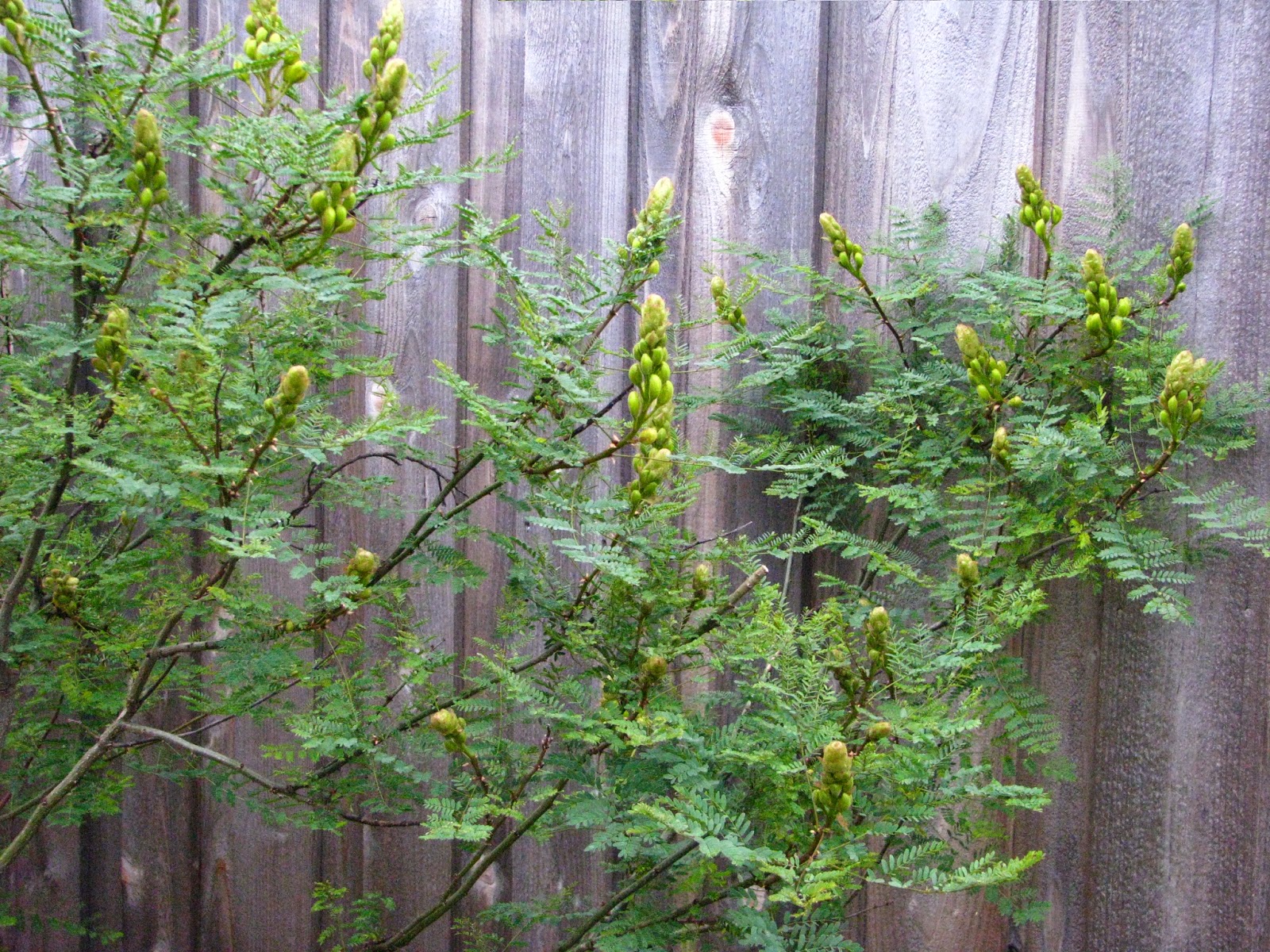
One plant people really wanted to see in bloom was the Mexican Bird of Paradise. The Garden Club volunteers were particularly interested in seeing the flowers, unfortunately the timing was just a couple of days off. One flower did open Saturday night and fell off by 2:00 on Sunday. I ended up printing a picture of the flowers and a volunteer hung it on a branch so visitors could see what the flowers look like.
Finally, I created this waterless water feature last year because I had a pile of rocks that I needed to hide. They still remain here, hidden in plain sight. Several people asked if I made the metal cattails. Unfortunately, I could not say that I did. I found them online at a reduced price. If you search the internet for metal cattails, you can find these (I did not pay that much for them.) and other metal cattails for sale.
That concludes my wrap up of my garden on the Plano Garden Club Garden Tour. I made a quick run through the other four gardens on the tour and I will share photos soon.
I think this will be the last public tour of my garden for a while because it is a lot of work getting ready for a tour and knowing this one was coming up kept me from making any major changes in the garden over the last year. I am ready to tear something up and make some changes and I can't do that knowing that the garden will be on display because my projects usually take too long. This year, it may be the constant rain that keeps me from any projects.