This week, October 20 through 26, 2013, is the fifth annual Texas Native Plant Week. Instead of posting more pictures of the native plants growing in my garden, I thought I would share pictures of some of the native plants I found growing at the Oak Point Park and Nature Preserve in Plano.

This was my visit to Oak Point on the east side of Plano. I arrived at 9 AM on a warm September morning and spent a couple of hours exploring a small portion of this 800 acre park.

Upon parking the car, the first things that caught my attention were the large prickly pear cactus plants in the parking lot medians.

The pads were covered in red fruit and spines. The plants were menacing, yet beautiful. I looked around for a broken pad to take home and start my own plant. I am not sure why because I can be somewhat accident prone and it would not be any fun trying to remove dead tree leaves that would inevitably gather in and around the prickly plants. I am not sure if this particular variety of Opuntia is native to Texas, but the parking lot plantings did include Texas natives, such as Mexican Feather Grass, Gregg's Mistflower, Zexmenia, Red Yucca, and Flame Acanthus. Non-native plants included Russian Sage and Fountain Grass.

Before I entered the park, I spent some time exploring the grassy area next to the parking lot. I was sure I would get chiggers from tromping through the grasses, but tromp I did. There were several prairie grasses growing in this area. I was able to identify Sideoats Grama in the lower left portion of this photo and the plumes of Indian Grass in the right center of the photo. It looks like this area was probably mowed a couple of months earlier.

Switchgrass is in the center of this photo. The blue flowers in the upper left corner are Pitcher Sage.

The Pitcher Sage was a little over a foot tall due to being mowed earlier in the year. When my plants are not cut back, they grow to about four feet tall.

Non-native Johnson Grass grows to the left of Indian Grass which is in the center of this photo. There was also quite a bit of Bermuda grass.

There were several patches of Purple Prairie Clover in this area. I also saw a couple of White Prairie Clover plants.

While trying to get a picture of the Purple Prairie Clover, I ended up focusing on a Little Blue butterfly.

I am pretty sure this is Maximillian Sunflower. They are probably in full bloom by now.

CollageMama often writes about her visits to this park. Through her posts, I found out that Illinois Bundleflower grows there. One of the things I wanted to do while at the park was to try to locate a plant and, possibly, some seeds. As it turns out, Illinois Bundleflower is everywhere in the park. Now I am not sure that I want it growing in my garden. None the less, I collected several seeds. The brown clusters in the photo above are little beans which house the seeds.

I think Illinois Bundleflower normally blooms earlier in the season. I was fortunate to find this one in bloom.

After 30 minutes or so in the parking lot, I finally approached the main entrance to the park.

This structure houses restrooms and a water fountain. A pavilion with picnic tables is on the opposite side of the main pathway. The lake is visible in the background.

For this visit, I thought I would stick to the paved pathway around the lake. Though not visible in this photo, there were several bikers and joggers on the paved pathway.
 The edges of the pathway are mowed to keep nature from getting too close. I frequently ventured into the unmowed areas because that was where the interesting plants were.
 I will travel down this side path another day.

A couple of Standing Cypress plants were preparing to bloom next to the pathway.
 A sign reminds visitors not to disturb the wildlife. Birds, squirrels, fish and insects were the only wildlife I observed.

The sun was already bright, so some of my photos were worse than usual. This is one one of them. At the edge of the wooded area, I noticed some False Indigo, Amorpha fruticosa, bushes, but the plant that drew my attention to the area was the six foot tall one with the white flowers.

It looked like a giant Gaura. I had never seen one of this size. The garden plants and wildflowers that you see along roadsides are usually no more than two feet tall. After some research, I think this is Longflower Beeblossom, Gaura longiflora.
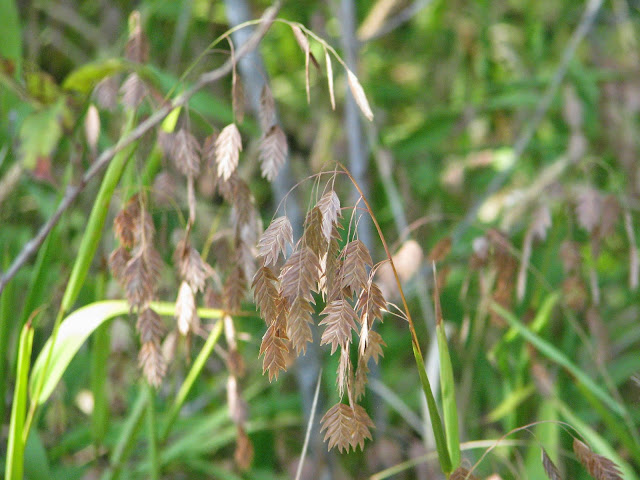
Inland Seaoats grass grows at the edge of the woods as well.

I saw several patches of Prairie Verbena along the pathway.

The tree, Maclura pomifera, is know by several common names, Osage Orange, Bois d' Arc, Bodark, Horse Apple, and Hedge Apple. The wood of the tree is extremely hard and the inedible fruits are said to repel cockroaches.

This is the entrance to one of the natural trail systems through the woods.

I stepped inside for a brief look around. The air felt considerably cooler when shaded from the sun. It makes me wonder why I have a prairie garden rather than a woodland garden. I will explore these trails on another day.

Canada Wild Rye grows in the shade of the trees.

Back at the lake, a Great Blue Heron was fishing for breakfast. He did not seem to mind all of the joggers and bikers passing by. As I slowly approached to get a better picture...

He flew to the other side of the lake.

He is over there somewhere. At the bottom of this photo are the yellow flowers of Buffalo Bur, Solanum rostratum.

This is a prickly plant in the nightshade family.

I thought the fruit of this unknown-to-me plant was interesting.

This was another plant I did not recognize.

It is not overly attractive, but I thought it was interesting. After the pink flower falls off, the pentagon shaped structure remains with a seed in the center. I collected a couple of seeds to see if I could start this plant in my garden. I hope it is not an invasive weed. Update: Thanks to a post on Window on a Texas Wildscape, I think I can identify this plant as a native Four O'clock, Mirabilis linearis.

A clump of Pickerel Weed grows at the edge of the water.

Another path for another visit. I traveled as far as the information sign to the left.
 The sign describes the blackland prairie and some of the plants and animals that once resided here (some still do).

Looking up from the sign is a grove of trees and prairie beyond.

This is not a pristine prairie for sure. It is a remnant at best. Much of the short grass is Bermuda. This would be quite a sight if the invasive species were removed and the original prairie species were allowed to grow (and not be mowed mid-summer). The park is in the news right now because the city has contracted to hold an annual weekend music festival in the park and preservationists are concerned about its effects on the prairie and the wildlife. Evidently, there is a purer parcel of prairie not far from this spot that could be damaged.


Back on the lake side of the pathway, I saw several butterflies hovering low and landing on some plants. I had to investigate. The butterflies were Monarchs and the plant was some sort of milkweed vine. I think Cynanchum laeve. The Monarchs were feeding on the flowers and laying eggs at the same time. Apparently, this is an extremely aggressive native plant, so maybe not a good candidate for my garden.

It was nice to see so many Texas native plants, like this Switchgrass, growing wild in Plano. I hope the city continues to preserve these plant species and they do not become victims of "progress". I wonder if any of the bikers and joggers ever slow down and take the time to notice the nature around them.

At this point, it was about 11:00 and I completed my route around the lake. It was starting to get pretty warm (hot) and the pathways that were filled with bikers and joggers were practically empty now. On the way back to the car, I found this pathetic looking cactus pad.
 I took it home and planted it in a pot. Here is how it looks a little over a month later. I wonder what I will do with a prickly pear cactus?
A couple of weeks ago, I was in Fort Worth and stopped at Weston Gardens In Bloom. It is not often that I am in Fort Worth, but when I am, I usually try to find the time to stop at this nursery.
Weston Gardens has a large selection of native plants and is the nursery where I found my Pine Muhly grass. On this visit, I bought a new Muhly grass that I was not familiar with, Bull Grass, Muhlenbergia emersleyi. This particular grass sells under the trademarked name, El Toro. More on this grass in the future.

Pam Penick at Digging declared October Support Your Independent Nursery month a few years ago and, during the month, she posts about nurseries in the Austin area. Since I took some pictures on my visit to Weston Gardens, I thought I would participate by featuring their demonstration gardens across the street from the nursery.

Before going through the gates to the demonstration gardens, I stopped for a look at this Retama, Parkinsonia aculeata, growing along the fence.
 The thorny tree is not commonly grown in the Dallas-Fort Worth area. I think it is interesting because it kind of looks like a blooming pine tree from a distance. I collected a seed pod on one visit, but none of the seeds sprouted. Now, on to the demonstration gardens...
 This is the entry into the former estate of Leon and Peggy Bandy which was developed during the 1930s and 1940s. When Randy and Sue Weston, the owners of Weston Gardens, purchased the 10 acre property in 1988, it was overgrown and in need of care. The Westons spent the next several years removing overgrown vegetation and replanting the gardens. My first visit to the gardens was probably in the mid 1990s, and I was in awe. I particularly liked the of the use of native plants, which was still uncommon at the time. This was also way before I even considered going lawnless. Another feature of the gardens that caught my attention was the stonework around the property. Where else will you find a rock ship docked next to a creek? The garden is still impressive, but some areas are showing signs of their age and could use a little rejuvenation.

To the left of the driveway is large lawn and a flowerbed planted with Caladiums and lined with pumpkins.

To the right are flowerbeds and an in-ground fountain gurgling with dirty water. This water in this fountain is dirty every time I visit. I assume muddy water washes in when it rains or the surrounding sandstone is decomposing and clouding the water.

Signage in the flowerbeds provides information about many of the plants growing in the gardens.

This stone pathway leads to a house on the property. I think the Westons live there. Even though this is a display garden, I avoid venturing too closely to the house out of respect for the owner's privacy. Cats, like the one sitting on this bench, are everywhere around the house.

I interrupted this cat while it was playing with a grasshopper.

Meanwhile, this big cat was guarding several pumpkins.

Even more pumpkins are around the corner awaiting selection.

To the left of the driveway is a large flagstone patio opening to an arbor that is covered with Wisteria.

Up the steps and beyond the wall is a large grassy area with mesquite trees. Wouldn't this area look nice if it was planted with prairie grasses and flowers?

Passing under the arbors and off to the left is the rose garden.

Down the center of the rose garden is a lily pond. The garden is frequently rented out for weddings and other events. Photos of some of the events are posted on their facebook page.

I am not sure what this big, strapping, grass-like creature is. I did not see a sign.

Looking back toward the arbor. A few antique rose bushes can be seen in the background. I think there are more perennials, native and adapted, in the rose garden than rose bushes.

In the background is the house where I believe the Westons live.

At the opposite end of the lily pond, under the arbor, is a statue that seems to have some form of leprosy. Each time I see her, more of her body is missing or piled next to her.

Back to the flagstone patio next to the arbor. Next we move down the stairs and toward the creek.

A large, multi-tiered koi pond begins near the arbor and travels down the slope of the property. At the top center of the photograph, behind the turk's cap, you can see water flowing over the first tier of the pond.

This is known as the Wedding Court. The main stonework dates to the 1930s and the fountain was added in 1992. It is said that Mr. Bandy paid his stone masons 50 cents a day during the Great Depression.

Looking back toward the flagstone patio at the top of the stairs.

A brick patio dominates this level of the garden. The white building in the background appears to be a garage with living quarters above.

This is the last level of the garden before approaching the creek. Notice the rock walls and steps extending into the background of the photo.
 There is a fairly steep drop to the creek, so a fence keeps visitors from getting any closer or falling into the creek. More stonework lines this side of the creek, including a changing house and a stone fireplace. I could not get get good photos due to limited access and plant growth. A bridge crosses the creek and leads to the rock ship, known as Old Ironstone.

The stone ship was completed in 1942 and was used for dances and parties. I wonder how many intoxicated partygoers fell into the water over the years? In 1972, the wooden cabin of the ship was destroyed by fire and was not restored until recently. Access to the ship is now limited to special events. There is a little kid in me that really wants to cross that bridge and take a look around.

This is a side view of the ship from the mid 1940s.

The photo above and the next three were taken on a previous visit on 11-11-06. I thought I would include them to show some of the fall colors along the creek.


 Weston Gardens and their historic demonstration gardens are interesting places to visit. If you are interested in the historical aspect of the demonstration gardens, there are several newspaper and magazine articles on their website in the "In the News" section. Here is a link to a Power Point document with some old photos and information about special events at the gardens.
Beebrush or whitebrush, Aloysia gratissima, is a favorite shrub in my garden. It grow about 10 feet tall and has an arching structure. The deciduous leaves are small and few. This gives bee-brush an open, airy look.
 Beebrush is in the verbena family and has fragrant flower spikes that are about three inches long. It blooms in spurts from spring through fall. The flowers usually follow rain by a few days, however it can be tricked into blooming with a water sprinkler.
 It rained some over the last couple of weekends and now the beebrush are in full bloom. The fragrance of the flowers fills the backyard. The flowers are usually described as smelling like vanilla. I guess that is true, but right now, with so many flowers, the strong scent is bordering on smelling like a bathroom deodorizer.
 I am creating a beebrush thicket in the backyard. Most of the plants are growing in full sun and dry soil, however one plant is slowly being shaded by an oak tree and a volunteer redbud tree. Several internet sources say beebrush is adaptable to shade and poorly drained soil.
 Texas native beebrush is often available at native plant sales. A closely related native to Argentina is sweet almond verbena, Aloysia virgata. Almond verbena is becoming more common in the local nursery trade. It is cold tender and dies to the ground in the winter in the Dallas area. From what I understand, almond verbena will quickly sprout from the roots in the spring. Beebrush is Texas tough and does not have any problems with our heat, cold, or drought.
 I usually have a few (less than 10) beebrush seedlings that sprout in the garden each spring. The seedlings are pretty easy to remove, transplant or plant in a pot to give away.
 How did beebrush get its name? The flowers attract lots and lots of bees.


