Tuesday, May 8, 2012

Can I Look at Your Lawn?

Back in the days when I had a nice lawn (organically maintained, of course), no one ever asked if they could look at my lawn. I guess there was no point. With a lawn, you can pretty much see all there is to see from the street. There is no need to get out of the car for an up close look. A blade of grass at the street looks just like a blade of grass near the house.

That all changed after I removed the lawn and planted native prairie plants. This year, especially, there have been a surprising number of people that drive up to my property, stop and ask if they can look at my garden or ask if I can identify plants for them. I have not asked, but I think people are more interested in water conserving landscape options after last year’s drought (and the drought that may be shaping up for this year?). Besides that, I think my plants are more interesting than the plants in a typical suburban landscape.

Many of the visitors tracked me down as a result of this blog. (Even readers from Singapore!) Others live nearby or were passing through the neighborhood when the colorful wildflowers that fill my prairie caught their attention. I could make it easier for future visitors to find my prairie by giving my address or at least my street name like Scott at Rhone Street Gardens, but where would be the challenge and fun of the hunt if I made it so easy? I give the city in my blog name, so that should be enough.

Wildflowers are arguably the most important feature of my prairie. Not only because they are attractive, but they provide an oasis for the native wildlife in the lawn desert of my neighborhood. Many varieties of butterflies and bees visit the flowers for nectar. Some butterflies select specific wildflowers to lay their eggs (think of monarchs and milkweed as one example). Wildflowers also attract other insects, which will attract lizards and birds. Birds will also feed on the seed of the dried flowers. And I can’t forget the hummingbirds that drink nectar from many of the flowers. No plastic hummingbird feeders with sugar water are needed here. Every year I “discover” new birds, butterflies, and bees in my prairie garden that I have never seen before. And here I am in the middle of a sterile neighborhood in the ninth largest city in Texas.

This week, May 7 through May 13, is National Wildflower Week. In celebration, here are photos of just a few of the wildflowers blooming in my prairie garden.


Standing on the sidewalk in front of my house and looking to the left, a number of wildflowers are in full bloom. Beginning at the top center are the flower spikes of Red Yucca, Hesperaloe parviflora. These flowers always have a hummingbird nearby, but I have not seen many yet this year. The blue flowers to the right are Mealycup Sage, Salvia farinacea. The larger yellow flowers on the right are a Coreopsis that appeared in the prairie after a two year absence. The smaller and more numerous yellow flowers are Four Nerve Daisy, Tetraneuris scaposa. The Four Nerve bloomed all through the mild winter and need a little dead heading to clean up the dried flowers. Off to the left is Salvia greggii and nearby are several similarly colored Rock Penstemon, Penstemon baccharifolius. Purple Winecup, Callirhoe involucrata, flowers are scattered throughout.

Here is a close up of the Rock Penstemon.

Looking to the right from the same spot on the sidewalk are more wildflowers. Clockwise from the upper left corner is a flower of the Black Sampson or Narrow Leaf Coneflower, Echinacea angustifolia. There are several Coneflower plants just outside the left frame of the photo. Next to the Coneflower is a naturally occurring white seedling of the purple Mealycup Sage. To the lady that is a caretaker of a cemetery in Plano: I forgot to mention that this variety of Mealycup Sage was found growing wild in an unwatered  cemetery in Texas on the graves of Henry and Augusta Duelberg. The purple variety is sold as Henry Duelberg Salvia and the white variety is sold as Augusta Duelberg Salvia. If you only plant the purple flowered plant, I think you will eventually have some white flowered plants as well. Continuing on the right side of the photo and in front of the Salvias are more Four Nerve Daisies, the Mexican native Pink Skullcap, Scutellaria suffrutescens, Indian Blanket, Gaillardia pulchella, on the left side of the photo and more Winecup in the center of the photo.
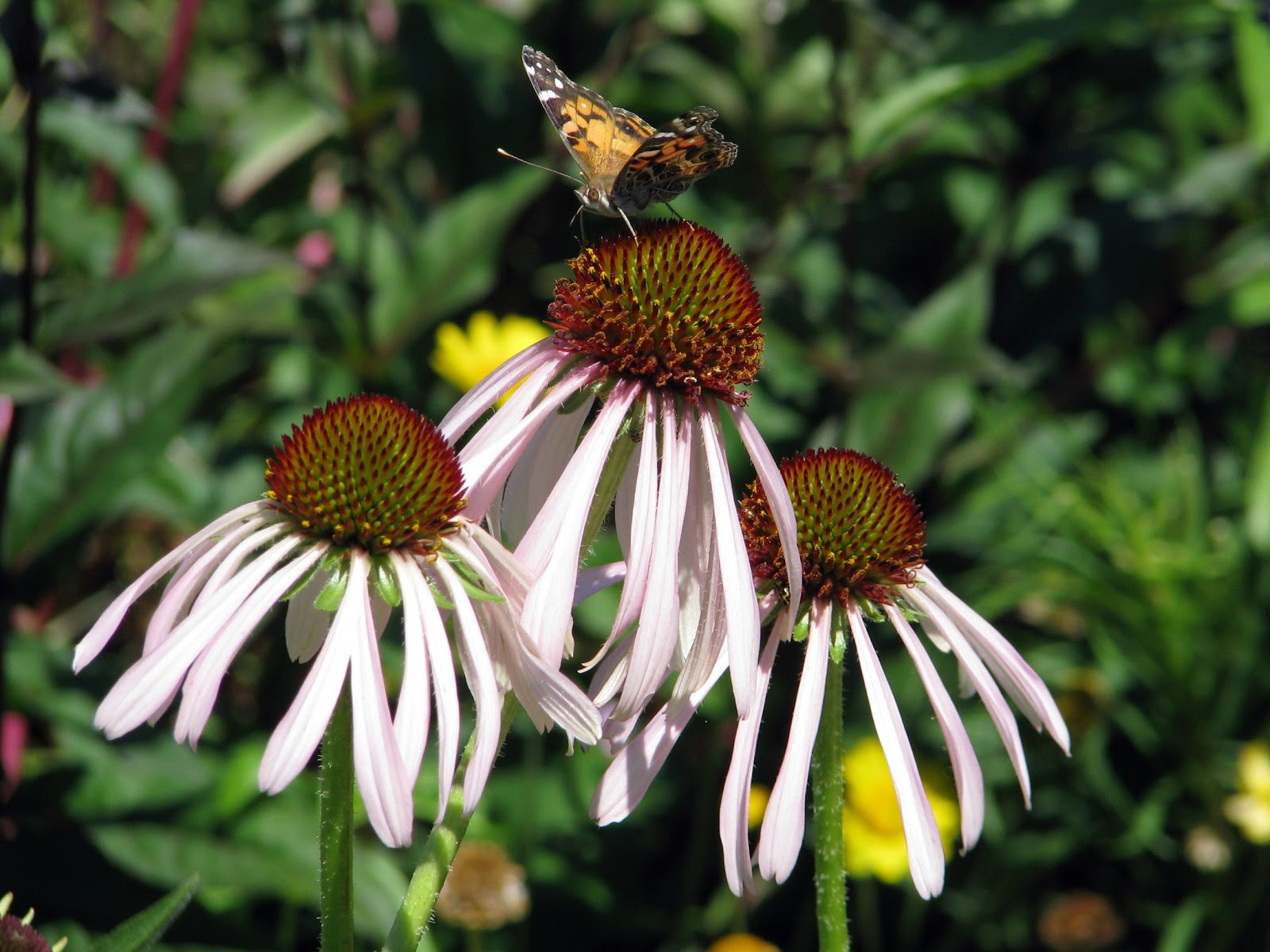
Here is a close up of the Black Sampson Echinacea with an accompanying Painted Lady butterfly. 

Here is another shot. I like how the petals gradually get longer as the flower ages and droop down like a hula skirt. My plants came from two different sources. Assuming they were correctly labeled, I have two variations of Black Sampson because the flowers of two plants are almost white, while the flowers of another plant are a darker pink.

Here is a close up of the Mealycup sage with Painted Lady butterfly.

A honeybee collects pollen on an Indian Blanket.

This is American Basket flower, Centaurea americana. I don't have as many plants as I would like because this is an annual and I have to rely on the plants reseeding each year. I only have two plants this year. Birds are supposed to like the seeds.

Asclepias tuberosa is one of three types of native milkweed that I have growing in my prairie. I also have a Mexican milkweed variety. Milkweed is the host plant for the caterpillars of monarch butterflies. 

If you let the caterpillars munch on a few leaves, you may be able to observe the metamorphosis from caterpillar to butterfly, as I did this year.  Monarchs are never far away when the Gregg's Mistflower, Conoclinium greggii, is in bloom. Monarch and Queen butterflies love Gregg's Mistflower.

Horsemint, Monarda citriodora, is another annual wildflower in my prairie. Horsemint is pretty and attracts bees and butterflies, but, unlike the American Basketflower, its numerous seeds sprout everywhere. The extra seedlings are easy to remove and the leaves have an interesting fragrance.

This is a variety of Gaura that I acquired from a vacant lot a couple of years ago. The original plant died after the first season and this new plant appeared nearby two years later.

The flowers of Chocolate Daisy, Berlandiera lyrata, smell like a chocolate perfume. The scent fills the air around the plants on still mornings. An Orange Sulphur butterfly (looks yellow to me) enjoys the nectar of the flowers.


Mexican Hat, Ratibida columnaris, grows large in my garden. Maybe a bit too large. It also reseeds easily. It is also another great bee and butterfly plant.


Aquilegia canadensis, Eastern Red Columbine, is wrapping up its blooming season for the spring.

Meanwhile, Symphyotrichum oblongifolium, a fall aster is blooming a few months early. A skipper enjoys the nectar of the flowers.

This is Snake Herb, Dyschoriste linearis. It is the one plant that every visitor to my prairie was most interested in this year. It is drought tolerant groundcover that grows in full sunlight in the parkway between the street and sidewalk. I will share more about this plant in a dedicated post soon. 


This is a Question Mark butterfly. One of the many butterflies found in my garden thanks to the wildflowers.

Saturday, April 21, 2012

Genus: Zanthoxylum

I have three small, spiny trees of the genus Zanthoxylum in my garden. Two of the trees were sold to me under the common name Toothache Tree (Zanthoxylum hirsutum) and one was sold as Hercules Club (Zanthoxylum calva-herculis). The common names of these trees are often used interchangeably and my trees look very similar, so it is possible that I assigned the wrong scientific name to one or more of these trees based on the provided common name. Regardless of which trees I may have, they are highly recommended for wildlife habitats.

In the spring, the trees are covered with clusters of greenish yellow flowers. The tallest of my trees reaches almost 6 feet and had more flowers this year than in previous years. I was surprised to find that the flowers have a rather strong scent that reminds me of honeysuckle. Here are a few photos of the many insects that were swarming around the flowers recently.


Common Buckeye Butterfly


Several Red Admiral Butterflies fed on the flowers of the trees


A Hairstreak Butterfly rested on a shiny and thorny leaf


A native bee that I will not attempt to identify


Another native bee that will go unidentified and a ladybug beetle


Honeybee and a fly


And a wasp fed on the nectar of the flowers.


But that's not all...

The trees are host plants for the caterpillars of the Giant Swallowtail Butterfly. The caterpillars are not always easy to see because they are camouflaged to look like bird droppings, as seen in this photo from a couple of years ago. I have not seen any caterpillars yet this year, but I did see a Giant Swallowtail flying around the garden a few days ago.

And there's more...
The flowers produce small fruits that are a favored by birds. I have not had any fruits on my trees yet. Maybe this year will be the first since there were so many flowers.

But that's still not all...
Humans can benefit from trees of the genus Zanthoxylum. If you get a toothache, you can chew on the leaves or bark of the trees and your mouth will become numb. Just watch out for the thorns.

Look for these trees at native plant sales this spring. The North Central Texas Chapter of the Native Plant Society of Texas has had Toothache Trees at their plant sales for the last couple of years. This was the source of my trees. Their spring plant sale is April 21 at the Fort Worth Botanic Garden. Toothache Tree is not on their list of available plants this year, but maybe they will have some anyway.

Tuesday, April 10, 2012

Native Plant Sales, a Plant Swap and Other Events

It is time again for spring native plant sales. This is your opportunity to get plants that are Texas tough and usually not found anywhere else. As usually happens, most of them are on the same day and at opposite ends of the Metroplex. Click here to jump to the Native Plant Society of Texas (NPSOT) website and a list of sales occurring across the state. Below, is my list of sales in the Dallas-Fort Worth area. Click the links for more information.

Spring Plant Sale at Fort Worth Botanic Garden, April 21, 9-2. In my opinion, this is the biggest and best local plant sale. Several vendors, including the North Central Texas Chapter of NPSOT will have a number of plants for sale. Here are some of the plants expected at the NPSOT area: Black Sampson, Blackfoot daisy, Chile pequin, Columbine, Eastern Bluemistflower, Eastern Redbud, Elderberry, Fall aster, Fall Obedient Plant, False Dragonhead, Fragrant phlox, Frostweed, Heartleaf Skullcap, Heath Aster, Lanceleaf coreopsis, Low Wild Petunia, Lyreleaf Sage, Mealy blue sage, Mexican feathergrass, Pigeon berry, Pink evening primrose, Purple aster, Rockrose, Salvia greggii ‘Ferman’s red’, Texas aster, Turks cap (red), Western bluemist flower, White yarrow, Winecup, White avens, White winecup (possible), Wild petunia. The other vendors may or may not have native plants.

Denton Redbud Festival, April 21, 10-4. The Trinity Forks Chapter of NPSOT will have native plants for sale. The couple of times I have been to this sale, they had some plants that I had not seen at other sales.

Collin County Master Gardeners Plant Sale, April 21, 9-3. This sale has a good mix of native plants and well adapted plants recommended by Texas A&M.

Texas Discovery Gardens Butterfly Plant Sale, May 12, 10-2. This sale features native and introduced plants that are favorite nectar or caterpillar host plants. Last year they had several varieties of milkweed. Members can shop a day early and beat the mob.

The Dallas Arboretum has an annual plant sale. I have never been. I could not find any information on their website. I imagine their sale has more introduced than native plants. Maybe I will go someday.

The Heard Museum usually has a spring native plant sale, but I do not see one on their schedule this year. Their Celebrate Nature Spring Festival is April 14 and could be a fun family event.

Learn 2 Live Green event is April 14 in Plano. No plant sales, but lots of green living info and family fun.

Lastly, a chance to get a piece of my prairie. The Custer Road location of Calloway's Nursery in Plano is sponsoring a Perennial Plant Swap on April 14 from 10-12. Their stores in North Arlington and Houston have swaps scheduled for the same time. Information about those sales can be found on the link.

I am posting information about the plants I am bringing below. Click on the links for even more information. If you want one of my plants, leave a message on the Calloway's website. I will not be able to honor requests for plants made on my blog. If anyone in the area would like to participate, sign up on the Calloway's site. The more the merrier and the better the plant selection!

Gregg's Mistflower, Conoclinium greggii, is a great butterfly plant. Blooms all summer, but heaviest in the fall when the monarchs pass through. It spreads, but not aggressively. Flowers are bluish purple. 3 available.

Willowleaf Aster, Symphyotrichum praealtum, blooms in the fall. Gets about 3 feet tall and spreads by underground roots. This plant will cover a large area quickly. Flowers are pink. 5 available.

Dallas Blues Switchgrass, Panicum virgatum, has bluegreen leaves throughout the summer. The flowerheads have a purple tint. Gets 5-6 feet tall. 5 available.

This is the fall color of Dallas Blues Switch Grass.

Red Yucca, Hesperaloe parviflora, is in the foreground with red flowers. Clumps slowly expand. Leaves are not sharp. Some clumps of Dallas Blues Switchgrass are in the background against the fence. 3 available.

Heartleaf Skullcap, Scutellaria ovata, has heart shaped leaves and purple flowers in the spring and early summer. The plants may die to the ground in the heat of the summer but will return in the fall. Makes a nice groundcover in sun or shade. 5 available.

Mealycup Sage, Salvia farinacea, has purple flowers and gets about 3 feet tall. I cut mine back after each flush of blooms and they will bloom again. Grows in sun to light shade. A favorite of bees and butterflies. 3 available.

Buffalo Currant, Ribes aureum, is a deciduous shrub with fragrant yellow flowers in the spring. I have not dug any of these yet, but I can if anyone is interested. Gets about 4 feet tall and wide. Looks better with some afternoon shade in the heat of the summer.

Plant Natives!