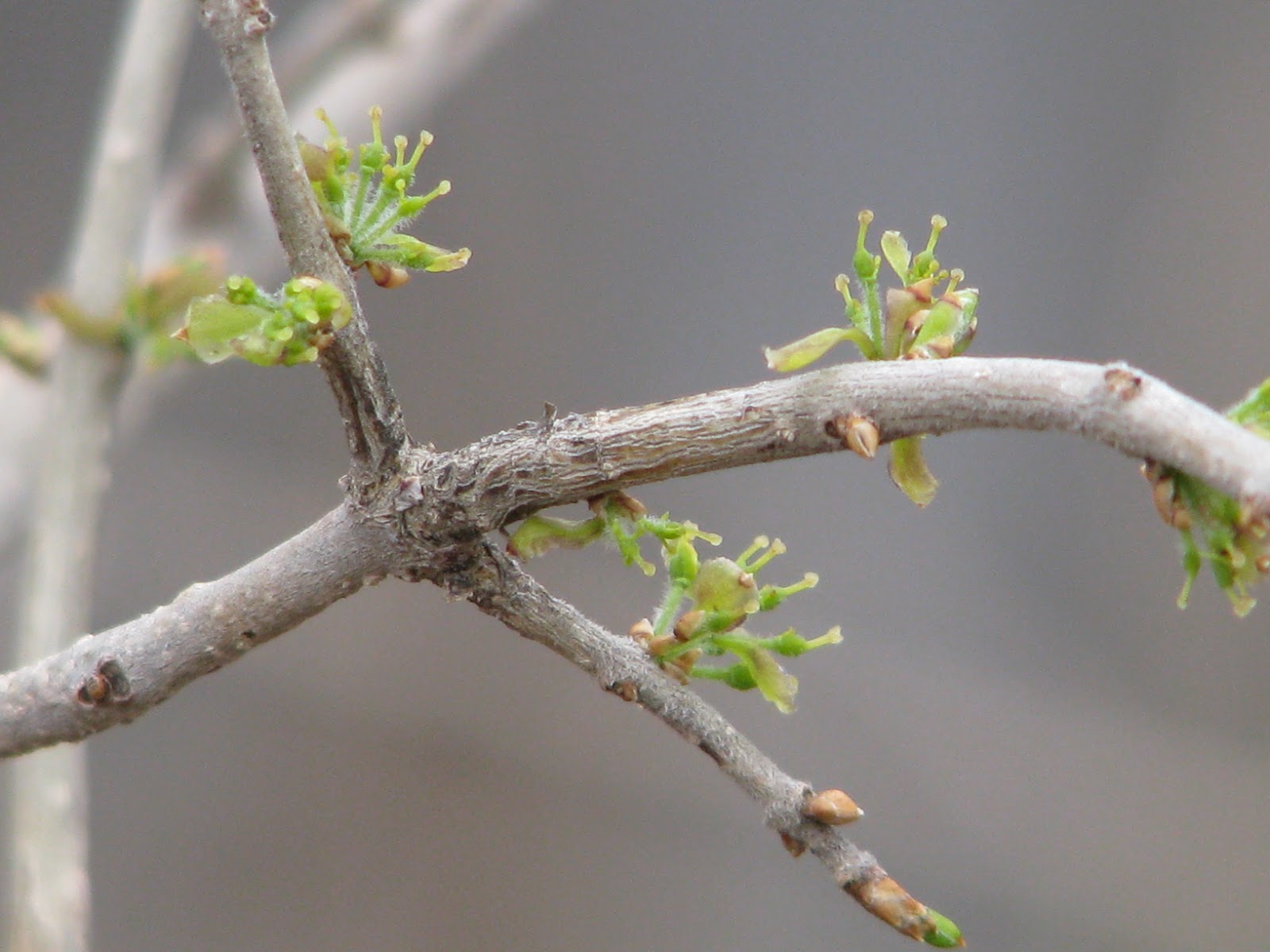
Forestiera pubescens, is an early blooming, deciduous shrub in the olive family and native
to this area. One of its common names, Spring Herald, references its early
bloom announcing the coming of spring. The shrub is probably more commonly
referred to as Elbow Bush which refers to the near 90 degree branching
structure of the limbs.
I read that Elbow
Bush is a good nectar source for bees and butterflies in late winter and early spring and birds are supposed to eat the the
fruit, so I decided I had to have one for my backyard wildlife habitat. Actually, I needed two plants because
the plants are dioecious. There are separate male and female plants and I would
need both for fruit.
I picked up one at
a nursery a few weeks ago during an end of season clearance sale. It would have
been nice to know the sex of the plants I was browsing, but they were all just a
bunch of twigs. No leaves or fruit. My main interest at the time was locating a live plant.
Good news! The
plant I selected was alive and started blooming a few weeks after planting.
After studying the flowers, I decided I had a male plant.
Botany Lesson One: The
yellow structures sticking out of the flowers are called the stamens. The long
part of the stamen is the filament and the oval part on the end is the anther
where pollen is produced.
Since my Elbow Bush
was blooming, the remaining plants at the nursery were probably in bloom as
well so I went back to see if I could locate a companion for my plant.
Magnifying glass in hand and probably looking a bit silly, I examined the
flowers on the Elbow Bushes at the nursery. I thought the flowers looked
different from the flowers on my plant, so I took a chance and bought another
plant.
More good news! My
second elbow bush was a female.
Botany Lesson Two: The structures sticking out
of these flowers are called carpels. The end is called the stigma and collects
pollen from the male flower. The tube leading to the swollen part is called the
style and the swollen parts in the middle are the ovaries. If pollinated, the
ovaries will eventually turn into dark purple fruit. (I think I identified all
of these flower parts correctly.)
It turned out that I must have picked the only male plant in the group when I bought my first Elbow Bush. I think I will go
back for one more female plant to finish off my Elbow Bush thicket. Here is a link to photos of Elbow Bush through various seasons.
Meanwhile, this warm winter is
heralding other signs of spring at least a month early.
Red Yucca, Hesperaloe
parviflora, is forming some flower stalks.
Rock penstemon, Penstemon
baccharifolius, is trying to bloom as is the Salvia greggii.
Possumhaw Holly, Ilex
decidua, is putting out new leaves.
Four nerve daisies,
Tetraneuris scaposa, have bloomed non-stop this winter.
It is hard to
believe that a year ago, yesterday, the prairie was covered in snow.